With WhatsApp’s huge user base of more than 2 billion and its higher engagement rates, organizations are progressively investigating its true capacity as a strong marketing tool. In the event that you’re scrutinizing the adequacy of WhatsApp marketing and the advantages of the WhatsApp Business API, this guide is customized for you. We’ll investigate key metrics and strategies to maximize your WhatsApp marketing ROI.
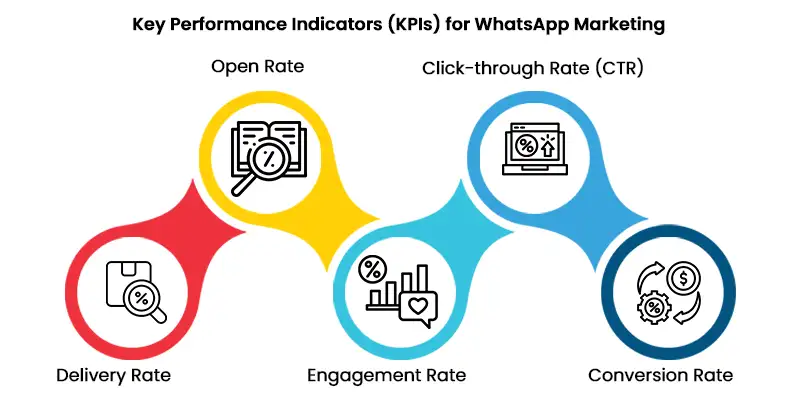
Measures the Productivity of your message delivery, ensuring content reaches your audience. Formula: (Number of messages delivered / Total messages sent) x 100%
Reflects how convincing and significant your content is to recipients. Formula: (Number of opens / Total messages delivered) x 100%
Check the Number of beneficiaries that cooperated with your substance. Formula: (Number of responses / Total messages delivered) x 100%
Evaluates the Effectiveness of your call-to-actions (CTAs) inside the message. Formula: (Number of clicks / Total messages delivered) x 100%
Tracks Recipients who made an ideal move, like making a buy or purchase or signing up for a newsletter. Formula: (Number of desired actions / Total messages delivered) x 100%
For a more profound examination, consider these high-level metrics to assess your marketing ROI and campaign profitability:
3. Return on Campaign Spend
Step 1: Prepare UTM Parameters
UTM (Urchin Tracking Module) parameters are tags you add to a URL. At the point when somebody clicks on a URL with UTM parameters, those tags are sent back to your analytics tool, and you can follow where your traffic came from.
For instance, in the event that you have a site https://example.com, you can add UTM parameters to it like this:
Step 2: Share the link on WhatsApp
When you have your abbreviated URL with UTM parameters, you can share it on WhatsApp. You can insert the link as a call-to-action interactive button so clients can respond without any problem.
Step 3: Analyze the Traffic
In Google Analytics 4, you can go to Reports > Acquisition > Traffic Acquisition to see the traffic from “whatsapp/social”.
Decide the Beginning of Contacts Utilizing These Methods:
Method 1: Customize The Initial Message
In the event that you’re utilizing a link to start a WhatsApp chat, you can customize the initial message based on the platform or campaign. For example, a link from an email campaign might have the initial message “Hi! I’m connecting from the email campaign,” while a link from your site could say “Hi! I tracked down you on your site.”
Method 2: Use Google Tag Manager
Google Tag Manager (GTM) is a powerful tool that can help you track clicks on a “Chat with us on WhatsApp” link or button on your website. By setting up tags and triggers in GTM, you can send this data to Google Analytics to determine the lead source.
Here’s a step-by-step guide on how to track WhatsApp link clicks using Google Tag Manager:
Step 2: Create A New Trigger
Whenever you’ve set up the tag and trigger, click on “Save”, “Submit” and “Publish” in the upper right to publish the changes to your live site.
Step 4: Check in Google Analytics 4
After some time, you can go to find out about Google Analytics and navigate to Report > Engagement > Events to see the events being tracked. If you set it up as described, you’d look for the “whatsapp_clicks”. With this event data, you can segment the events by source/medium to see where users were before they clicked on the WhatsApp link. This can give you insights into which channels or campaigns are driving the most WhatsApp interactions.
The WhatsApp API likewise empowers organizations to actually target explicit audiences more. For instance, if a broad targeting approach fails to engage customers, businesses can create a more tailored audience list based on conversation histories and customer interests.
You can then test the effectiveness of different messages for specific demographics, interests and behavior, so that your targeting and messaging strategies resonate better with the intended audience.
Organizations can assess the adequacy of various CTAs, message content, visual components, timing and frequency in driving conversions.
This iterative cycle process organizations to constantly further develop their conversion rates and achieve better results in their WhatsApp marketing efforts.
WhatsApp Business API can assist businesses establish automated conversation flows and guide users on the next steps depending on the replies.
By planning a succession of message formats with button-based reactions, you can give clients helpful answer choices and a consistent correspondence experience. This step-by-step approach encourages customers to take desired actions.
It guarantees that specialists have state-of-the-art data which empowers them to serve clients all the more really and abstain from posing repetitive inquiries, streamlining the communication processes for overall customer satisfaction.