Before sending a message, have you at any point halted to figure whether to utilize WhatsApp or Short Message Service (SMS)?
Presently, it could be a simple decision nowadays; yet for businesses figuring out some way to converse with their audience, it can have an enormous effect.
Yet, which one is better for engaging your audience?
This blog entry separates both WhatsApp and text marketing, what they offer, where they miss the mark, and which may be the best fit for your marketing efforts.
Prior to picking one of the two channels for message marketing, it is essential to comprehend which one is an ideal choice for your business to save expenses and increase ROI (Return on Investment).
Ready to dive in? Let’s get started.
As the name recommends, this includes utilizing WhatsApp to promote your products and services, boost sales, and build trust. You can send different types of messages and offer quick customer support on a platform where 3.1 billion individuals spend around 40 minutes every day.
WhatsApp has become something beyond a talking application. It is currently a strong way for businesses to connect with their audience on a personal level.
Consider it an extra team that helps build relationships, promote products/services, share updates, answer clients’ inquiries and resolve their issues.
How about we take a gander at the pros and cons of utilizing WhatsApp marketing.
Engaging Content – WhatsApp marketing messages can be texts, images, GIFs or videos. Rich media help create engaging marketing campaigns efforts that people remember.
High Open Rates – WhatsApp messages have a 98% open rate, much higher than most marketing channels like emails.
Personal Touch – Direct discussions with clients take into account custom-made messages, making communications feel more private and effective.
WhatsApp Broadcast – WhatsApp empowers you to send more than 1000+ messages (or limitless in view of your Meta limit) immediately with broadcast choices.
Conversation Window – WhatsApp empowers you to message your client free of charge inside a 24-hour message window.
Internet Dependency – Needs a internet connection with send and get messages, which can restrict arrive at in regions with poor connectivity.
Administrative Imperatives – Businesses should observe information protection regulations, which can shift by country and affect how they engage with clients.
Security Concerns – In spite of the fact that WhatsApp offers end-to-end encryption, a few clients are wary, which impacts their eagerness to engage in conversations on the platform.
Platform Limitations – WhatsApp likewise has specific constraints on message frequency. You should likewise have your clients select in on WhatsApp to have the option to message them.
Short Message Service (SMS) marketing, otherwise called text marketing, is when businesses send promotional messages to clients through instant messages.
Indeed, even with different messaging applications and social media platforms around, SMS is as yet an extraordinary method for arriving at your customers.
Text marketing is known to be quick, solid, and best for sending urgent information like flash sales or expiring discounts. The sent messages pop up right on your client’s telephone screen making them unavoidable.
We should perceive how SMS marketing can benefit and restrict your marketing efforts.
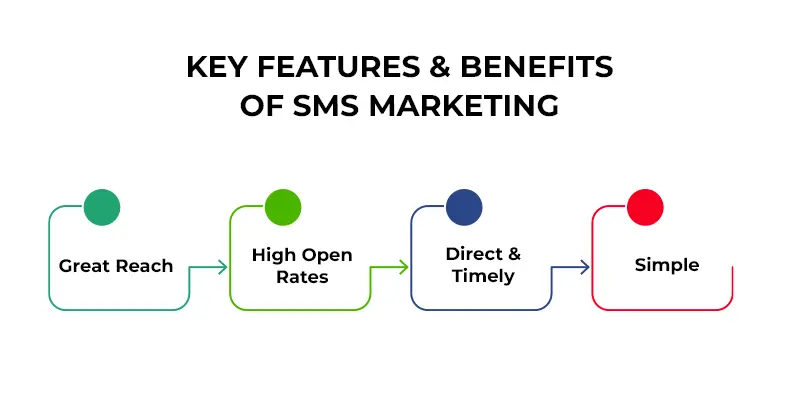
Great Reach – Nearly all phones can receive & send SMS. This means you can reach a majority of your target audience via text messages, even without the Internet.
High Open Rates – Text messages have a higher open rate (over 90%) than emails.
Direct and Timely – People often check their messages—usually within a few minutes. This makes SMS marketing an urgent mode of communication.
Simple – Texts are easy to use. You don’t need any complex apps, tools, or training to send and receive text messages.
Wider Demographic Appeal – People of all ages can read and use SMS easily. Text messages work well for people who don’t know much about tech.
Character Limits – Every SMS text has a constraint of 160 characters. This implies less data can be shared in one message.
Go to Settings: Tap on the three dots in the upper-right corner (for Android) or the gear symbol in the base right corner (for iPhone) to get to the settings menu.
No Rich Media – No photos, videos, or cool stuff can go in texts. Simply words make it less tomfoolery.
Regulatory Scrutiny – SMS marketers need to follow rules that limit unsolicited messages.
Spam Insight – Your customers could feel you are spamming them with promotional text messages, which can affect engagement and brand perception.
Costs – Contingent upon the volume and objective, sending text messages can get expensive.
Since it is now so obvious how viable both WhatsApp and SMS marketing can be, we should have a quick look at how they differ from each other.
With regards to customer engagement, WhatsApp marketing holds a few benefits over SMS, making it a more unique and interactive platform for organizations. How it’s done:
WhatsApp upholds text messages as well as images, videos, audio files, and documents. This great many prospects makes it flexible for you to construct a superior visual campaign.
WhatsApp is a great messaging application that along with real-time interactions, makes it practical for organizations to lay out an exchange with their clients. It additionally gives data and quick feedback.
Group Audience Based on Filters
Not at all like SMS, you can channel and group your audience or customers based on their interests or any other criteria to start sending targeted, personalized messages via WhatsApp broadcast and WhatsApp drip marketing.
WhatsApp messages are open, exceptionally private, and nosy, making it a more well-known method of messaging than texts. They interface better with your target audience or customers than SMS, leading to better engagement.
Enhanced Security and Privacy
Start to finish encryption makes WhatsApp communication protected and secret for both you and your clients while SMS is defenseless against dangers of interference.
Business-Friendly Features
WhatsApp Business and WhatsApp Business API are two unique platforms explicitly intended for WhatsApp marketing. You can send automated messages, set up speedy answers, improve your business profiles, make product catalogs and significantly more. SMS doesn’t support any of these powerful features.
With regards to thinking up a effective marketing strategy for your WhatsApp marketing campaigns, this is the way you ought to go about it:
1. Know Your Audience & Set Goals
Begin by grasping your audience. Who are they? What do they like? What are their perspectives toward the brand? Then, at that point, put forth your campaign goals accordingly.
Use WhatsApp Business or WhatsApp Business API in light of your prerequisites. In the event that you are simply beginning with WhatsApp marketing and need to attempt it at a limited scale, then start with WhatsApp Business Application, and if you need to grow then coordinate WhatsApp Business API to your WhatsApp business for cutting edge highlights.
Be that as it may, attempting to explore the WhatsApp Business API can be testing and you really want an accomplice to make the whole interaction more straightforward. Go for a WhatsApp Promoting instrument like InfinityHub WhatsApp to get the greatest maximum ROI.
3. Build Your Contact List
Develop your contact list organically by empowering your clients to select in for your WhatsApp messages utilizing the WhatsApp Talk gadget highlights.
4. Craft Engaging Content
You can make successful WhatsApp message templates according to the kind of campaigns you need to send off. Add pictures and GIFs to make them more alluring outwardly.
5. Automate Common Responses
6. Monitor and Analyze Performance
Measure your campaign’s performance on InfinityHub WhatsApp, take vital choices, and improve your campaigns as needs be.
Make a point to get unequivocal assent prior to adding clients to your contact list and give clear quit choices in your messages.